
Artificial intelligence models can answer questions, write content, summarize documents, and help with complex tasks.
But every AI model has a limitation: it does not automatically know your private information, company documents, latest product updates, or recent changes.
This is where RAG comes in.
RAG stands for Retrieval-Augmented Generation.
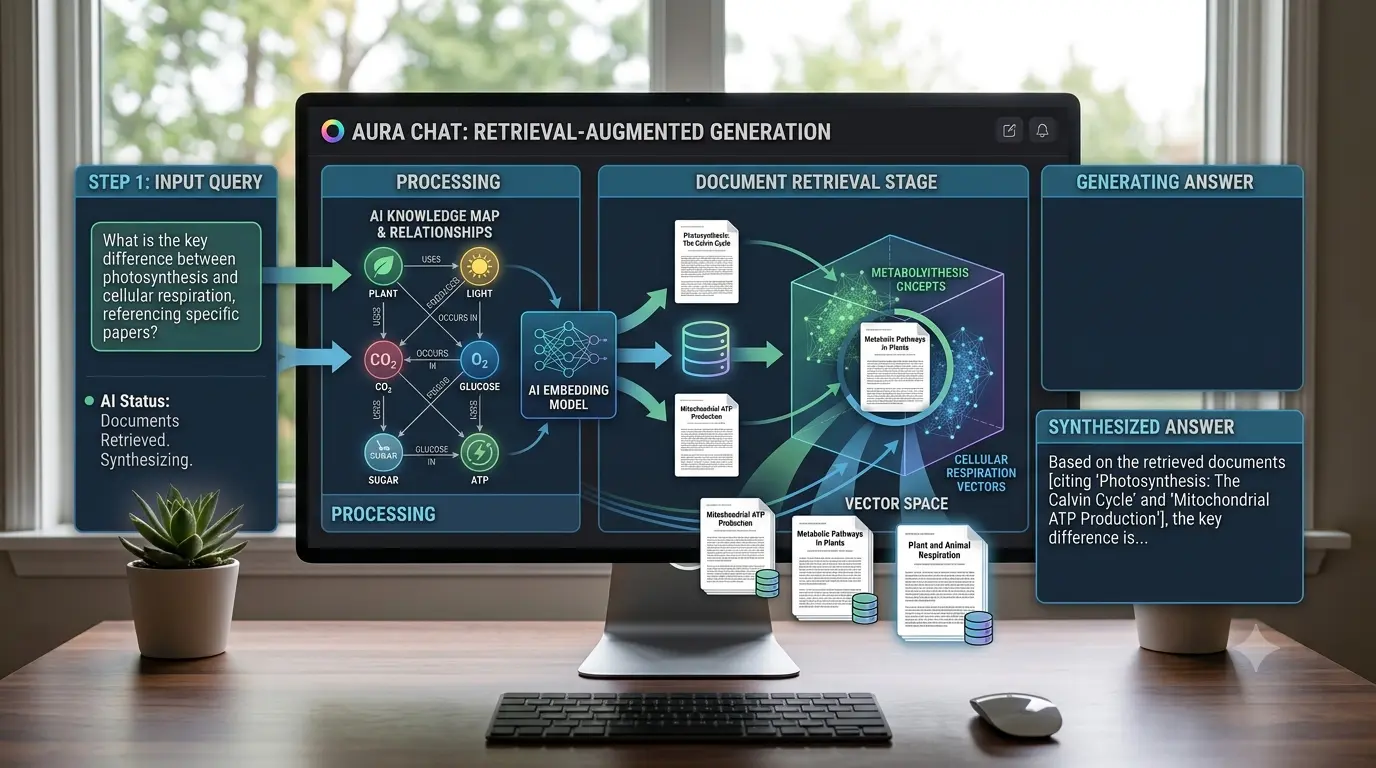
RAG allows an AI model to search for relevant information first, then use that information to create an answer.
What Is RAG?
A normal AI conversation works by generating answers from the model’s training and available conversation information.
A RAG system adds another step:
1. User asks a question.
2. The system searches a knowledge source.
3. Relevant information is retrieved.
4. The AI generates an answer using that information.
Why Was RAG Created?
Large language models have limitations:
– They can have outdated information.
– They do not know private company data.
– They can hallucinate.
RAG helps by providing relevant source material before generating a response.
How RAG Works
Step 1: Collect Information
Documents such as manuals, product documentation, support articles, research papers, and internal files are prepared.
Step 2: Create Embeddings
Documents are converted into embeddings that help systems compare meaning.
Step 3: Retrieve Relevant Information
The user’s question is compared with stored information and matching sections are selected.
Step 4: Generate the Answer
The AI receives the question, retrieved information, and instructions before creating the final response.
RAG Is Not Training the AI Model
Training changes the model itself.
RAG gives the model access to additional information during a request.
Training teaches new patterns permanently.
RAG provides the right documents before answering.
Where RAG Is Use
RAG is commonly used for:
– Customer support assistants.
– Internal company knowledge systems.
– Research assistants.
When You Actually Need RAG
Most everyday tasks do not require RAG.
You usually do not need it for:
– Writing emails.
– Brainstorming.
– Creative writing.
– General explanations.
RAG becomes useful when answers depend on specific information.
Signs You Need RAG
You may need RAG if:
– You have private information.
– Information changes frequently.
– Accuracy depends on specific sources.
RAG vs Fine-Tuning
Fine-tuning changes how an AI behaves.
RAG changes the information available to the AI.
Fine-tuning is useful for style and response patterns.
RAG is useful for current information and large document collections.
The Limits of RAG
RAG is not a perfect solution.
Problems can still happen when:
– Documents are outdated.
– Information is incorrect.
– Retrieval fails.
– The AI misunderstands retrieved content.
Does Every Business Need RAG?
No.
RAG is useful when information volume or complexity creates a real problem.
The goal is not to add AI everywhere.
The goal is to solve an information problem.
The Practical Takeaway
RAG does not make an AI model smarter.
It makes the AI better informed by giving it access to relevant information when needed. For private data, changing information, or knowledge-heavy tasks, RAG can make AI systems much more useful.