
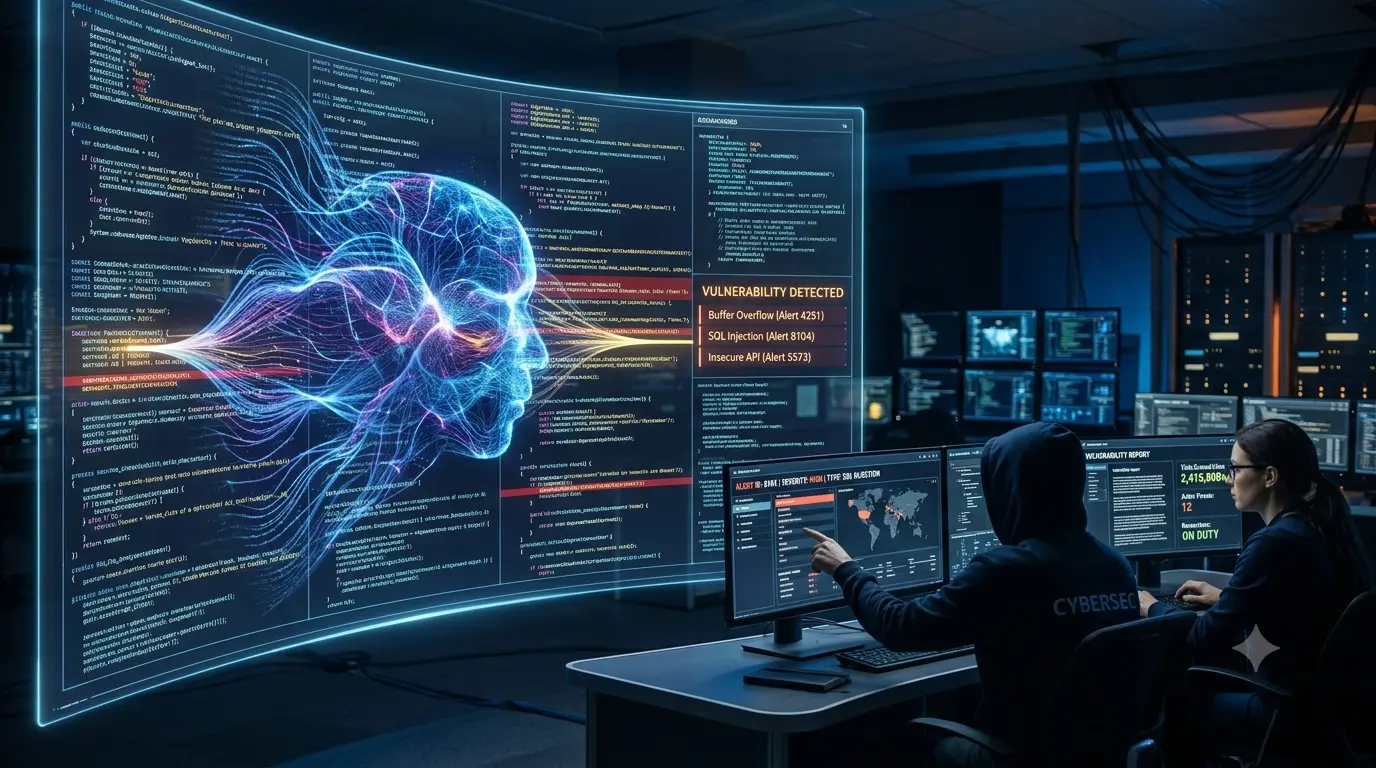
For years, cybersecurity has followed a familiar pattern.
Security researchers search for weaknesses.
Companies patch those weaknesses.
Attackers try to find them before they are fixed.
Artificial intelligence is beginning to change this cycle.
AI systems are now being tested for their ability to discover software vulnerabilities, analyze security problems, and assist researchers during investigations.
That creates an interesting possibility:
AI could become one of the strongest cybersecurity tools ever created.
But it also creates a difficult question:
What happens when the same technology that helps defenders can also help attackers?
AI Is Becoming a Security Research Tool
Finding vulnerabilities is difficult.
Modern software systems contain millions of lines of code and countless possible interactions.
A single overlooked mistake can create a security problem.
Traditional security research involves:
- Manual code reviews.
- Automated scanners.
- Penetration testing.
- Security audits.
These methods are still important.
However, AI can help researchers process information faster.
An AI system can analyze code, search for suspicious patterns, and suggest areas that require investigation.
How AI Can Help Find Vulnerabilities
AI-powered security tools can assist in several areas.
Code Analysis
Large software projects are difficult for humans to review completely.
AI can examine code and identify patterns connected to possible weaknesses.
Examples include:
- Unsafe data handling.
- Authentication problems.
- Incorrect permissions.
- Vulnerable dependencies.
AI does not replace security engineers.
It helps them focus their attention.
Automated Testing
Security testing often requires checking many possible scenarios.
AI agents can help create test cases and explore possible attack paths.
This could allow researchers to discover problems earlier.
Faster Investigation
When a security issue appears, teams need to understand:
- What happened.
- Which systems are affected.
- How serious the problem is.
- What actions should be taken.
AI can help summarize information and speed up investigations.
AI Finding Bugs Is Not the Same as AI Hacking
Recent demonstrations of AI systems discovering vulnerabilities have created discussion around AI security.
However, there is an important difference.
Security research environments are controlled.
Researchers design tests to understand what AI systems can do.
That does not mean AI systems can independently break into any target.
The reality is more complicated.
AI can become a powerful assistant for security work, but it still depends on:
- Access.
- Permissions.
- Instructions.
- Available tools.
The Security Risk: Attackers Can Use the Same Technology
The biggest concern is not that AI suddenly becomes a hacker.
The concern is scale.
Attackers could potentially use AI to:
- Search for software weaknesses.
- Create convincing phishing messages.
- Automate reconnaissance.
- Analyze stolen information.
Cybersecurity has always been an arms race.
Every defensive improvement creates new offensive opportunities.
AI accelerates both sides.
Why AI Vulnerability Discovery Matters
The biggest advantage of AI security tools is speed.
A vulnerability discovered today can potentially be fixed today.
A vulnerability discovered months later may already have been exploited.
AI could help shorten the time between:
Finding a problem.
Understanding the risk.
Deploying a fix.
That could improve security across the industry.
The Problem of Trusting AI Security Tools
Security teams need to be careful.
AI systems can make mistakes.
A tool may:
- Misidentify harmless code as dangerous.
- Miss a real vulnerability.
- Suggest an incorrect solution.
Security decisions cannot rely on AI output alone.
Human review remains necessary.
A security engineer needs to understand the context before making changes.
Businesses Need Better AI Security Practices
As companies adopt AI tools, they need to think about security differently.
Important questions include:
- What data can the AI access?
- What actions can it perform?
- Who reviews its recommendations?
- How are AI tools monitored?
The same principles used in traditional cybersecurity still apply.
Limit access.
Monitor activity.
Review important actions.
Small Businesses Will Also Be Affected
AI security is not only a concern for large technology companies.
Small businesses increasingly rely on:
- Website platforms.
- Cloud services.
- AI assistants.
- Automation tools.
Many smaller organizations do not have dedicated security teams.
AI tools could help them improve protection.
But they also need to avoid blindly trusting automated systems.
Security tools are only effective when configured correctly.
The Future of AI-Powered Cybersecurity
AI will likely become a standard part of cybersecurity.
Future security systems may include:
- AI vulnerability discovery.
- Automated threat analysis.
- Real-time monitoring.
- Faster incident response.
The goal is not to create a fully autonomous security system.
The goal is to help security teams work faster and make better decisions.
The Practical Takeaway
AI could transform cybersecurity by helping researchers find vulnerabilities before attackers do.
But the same technology creates new risks.
The future security landscape will not be defined by AI alone.
It will be defined by how responsibly companies use it.
AI can become one of the best defensive tools available.
But only if organizations combine it with strong security practices and human oversight.