
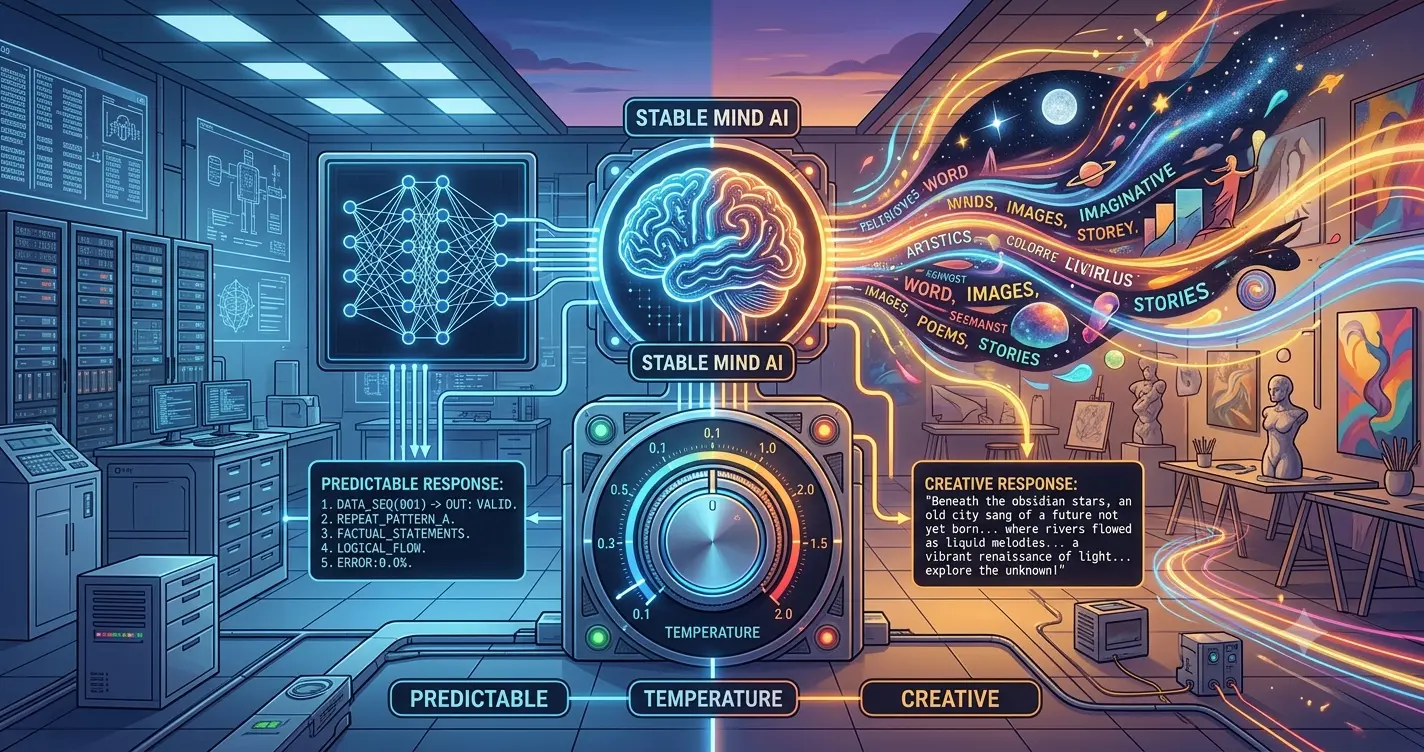
When people use AI tools like ChatGPT, Claude, or Gemini, they often assume the model simply answers based on what it knows.
Behind every response are settings that influence how the model generates text. One of the most misunderstood settings is temperature.
Temperature controls how predictable or varied an AI response can be.
A lower temperature usually makes answers more consistent and focused. A higher temperature allows more variation and creativity.
Higher does not mean better.
What Does AI Temperature Mean?
Temperature is a setting that affects how an AI model chooses its next words.
When an AI generates a response, it calculates probabilities for possible next words. A low temperature keeps the model closer to the highest-probability choices, while a higher temperature allows less likely options.
Think of Temperature Like a Creativity Dial
Low temperature:
– Direct answers
– Consistent wording
– Fewer surprises
– Predictable results
Useful for:
– Technical explanations
– Data extraction
– Summaries
– Code generation
High temperature:
– Unusual phrasing
– Different ideas
– More varied structures
Useful for:
– Brainstorming
– Creative writing
– Marketing concepts
Why Temperature Does Not Make AI Smarter
Temperature does not add knowledge, improve reasoning, or increase accuracy. It only changes the selection process during generation.
The model itself matters more than the temperature setting.
Where Temperature Is Used
Most consumer chat apps hide temperature controls. Developers using AI APIs can usually control it directly.
The correct value depends on the task.
Understanding Temperature Values
Typical ranges:
0.0–0.2:
Very consistent and predictable. Useful for facts, extraction, coding, and structured tasks.
0.3–0.7:
Balanced creativity and accuracy. Useful for general writing and explanations.
0.8–1.2:
More varied responses. Useful for brainstorming and creative work.
1.3+:
Highly unpredictable. Useful for experimental ideas.
Why 0.7 Became the Default
Many developers use 0.7 because it provides a middle ground between consistency and creativity.
However, there is no universal best temperature.
Real Examples
A low temperature may produce safe, common suggestions. A higher temperature may produce more original ideas but also less practical ones.
Why Low Temperature Is Better for Important Tasks
Tasks like document summaries, coding, and information extraction usually require reliability more than creativity.
Why Higher Temperature Helps Creative Work
Creative tasks benefit from different ideas and unusual combinations. Higher temperature can help generate more variety.
Temperature and AI Hallucinations
Higher temperature can increase unusual responses, but hallucinations are mainly caused by missing information, unclear prompts, and model limitations.
A temperature of zero does not make AI perfectly accurate.
Why Chat Apps Hide Temperature Controls
Most users do not need to manage technical generation settings. AI companies handle this through default settings, system instructions, safety layers, and interface design. Temperature is one tool among many for controlling AI behavior.