
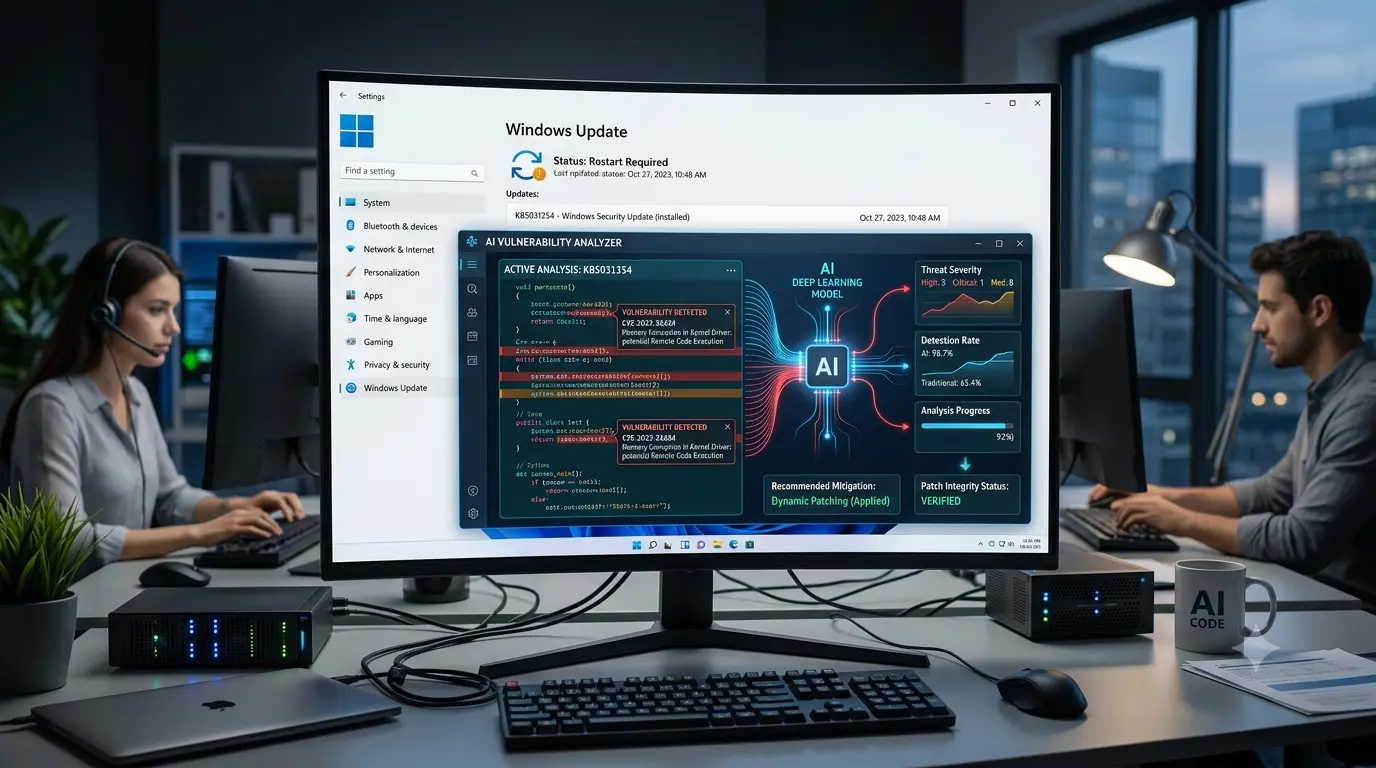
Microsoft security updates usually arrive quietly.
A notification appears.
A restart is required.
Most users move on.
But behind those routine updates is a much larger battle between software companies and attackers trying to find weaknesses before they are patched.
Microsoft’s recent security efforts highlight a major shift in that battle:
Artificial intelligence is becoming part of how vulnerabilities are discovered, analyzed, and addressed.
The company has been expanding the use of AI-assisted security methods to help researchers identify problems faster and improve vulnerability management.
The goal is simple:
Find security flaws before attackers can use them.
But as software becomes more complex, the challenge is becoming harder.
Why Microsoft Is Turning to AI for Security
Modern software is enormous.
Windows alone includes millions of lines of code and supports countless hardware configurations, applications, and business environments.
Finding every possible security issue manually is almost impossible.
Security researchers have traditionally relied on:
- Manual code reviews.
- Automated scanners.
- Testing environments.
- Threat intelligence.
These methods remain important.
However, AI can add another layer by analyzing large amounts of information and identifying patterns that humans may miss.
The Growing Problem of Software Vulnerabilities
Every major software platform faces vulnerabilities.
These weaknesses can affect:
- Operating systems.
- Applications.
- Cloud services.
- Drivers.
- Enterprise tools.
Attackers often search for these weaknesses because an unpatched vulnerability can provide access to systems.
The time between a vulnerability being discovered and being exploited is becoming increasingly important.
This creates a race:
Security teams need to find and fix problems quickly.
Attackers want to discover them first.
How AI Can Help Find Security Problems
AI-assisted security systems can help researchers in several ways.
Faster Code Analysis
Large software projects contain huge amounts of code.
AI can analyze sections of code and identify areas that may deserve additional review.
It does not replace security researchers.
Instead, it helps direct attention toward possible risks.
Finding Patterns
Many security problems share similar characteristics.
AI models can recognize patterns connected to:
- Weak authentication.
- Unsafe data handling.
- Incorrect permissions.
- Potential attack paths.
This can help researchers investigate problems earlier.
Improving Security Response
When vulnerabilities are discovered, teams need to understand:
- How serious the issue is.
- Which systems are affected.
- How quickly it needs to be fixed.
AI can help summarize technical information and organize response efforts.
Why Patch Numbers Matter Less Than the Process
Security updates often attract attention because of the number of vulnerabilities fixed.
However, the number alone does not tell the complete story.
A smaller update can still be extremely important if it fixes a critical vulnerability.
A larger update may include many lower-risk issues.
The bigger change is not simply how many problems Microsoft fixes.
It is how quickly companies can identify and respond to those problems.
AI Is Changing the Security Race
The use of AI in cybersecurity creates a new competition.
Security teams can use AI to:
- Analyze threats faster.
- Review code.
- Detect unusual activity.
- Automate parts of investigation.
Attackers can also use AI to:
- Create more convincing phishing attempts.
- Search for weaknesses.
- Automate parts of attacks.
The technology itself is neutral.
The advantage depends on who uses it better.
What This Means for Windows Users
For normal Windows users, the biggest takeaway is simple:
Updates matter.
AI may help Microsoft discover vulnerabilities faster, but protection still depends on users installing security updates.
Good security habits remain important:
- Enable automatic updates.
- Use multi-factor authentication.
- Avoid suspicious downloads.
- Keep browsers and applications updated.
- Use strong passwords.
AI does not remove the need for basic security.
What This Means for Businesses
Businesses face a bigger challenge.
A company may have:
- Hundreds of devices.
- Multiple applications.
- Cloud services.
- Employee accounts.
Managing security manually becomes difficult.
AI-assisted security tools could help smaller teams monitor systems more effectively.
However, businesses still need proper security processes.
Technology alone cannot fix poor security practices.
The Future of AI-Assisted Security
AI will likely become a normal part of cybersecurity.
Future security systems may combine:
- AI vulnerability discovery.
- Automated testing.
- Threat intelligence.
- Human security experts.
The goal is not creating fully independent security systems.
The goal is helping people detect problems earlier and respond faster.
The Practical Takeaway
Microsoft’s use of AI in vulnerability management shows how cybersecurity is changing.
The next generation of security will not rely only on faster patches.
It will depend on finding problems before they become attacks.
AI will become another tool in the security toolbox.
But the fundamentals remain the same:
Update your software.
Protect your accounts.
Treat security as an ongoing process.