
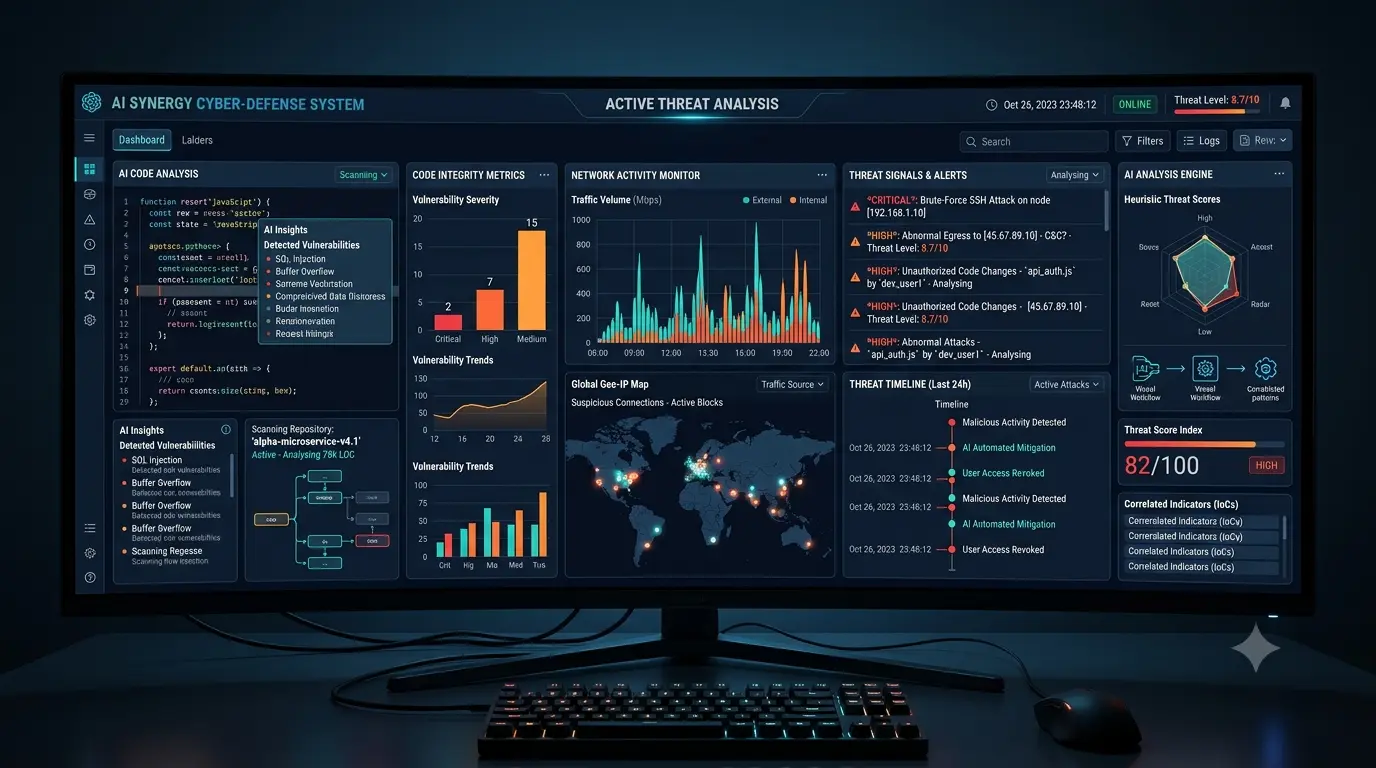
For years, security teams have used software tools to detect threats, investigate vulnerabilities, and respond to attacks.
Now, both sides of the battle are getting a new weapon:
Artificial intelligence.
Microsoft is expanding its use of AI in cybersecurity with new research and models designed to help find vulnerabilities, analyze threats, and improve security operations.
The idea is simple:
If attackers are using AI to discover weaknesses faster, defenders need AI-powered tools to keep up.
But this also raises an important question:
Can AI actually make cybersecurity safer, or will it simply speed up the race between attackers and defenders?
Microsoft’s Push Toward AI-Powered Security
Microsoft has been investing heavily in AI security research.
The company has introduced cybersecurity-focused AI projects, including models designed to assist with vulnerability discovery and security analysis.
One example is MAI-Cyber-1-Flash, a cybersecurity AI model designed to help identify software weaknesses and assist security researchers.
Microsoft has also discussed Project Perception, an effort focused on using AI to analyze security information and improve defensive capabilities.
The goal is not to replace cybersecurity professionals.
Instead, Microsoft wants AI systems to handle some of the repetitive and time-consuming work that slows security teams down.
Why Cybersecurity Needs AI Assistance
Modern software systems are extremely complex.
A single application may contain:
- Millions of lines of code.
- Multiple third-party components.
- Cloud infrastructure.
- User accounts.
- External integrations.
Security teams cannot manually inspect everything.
Attackers know this.
Cybercriminal groups increasingly use automation to:
- Scan for vulnerabilities.
- Search for exposed systems.
- Create phishing campaigns.
- Test stolen credentials.
AI makes these attacks faster and easier to scale.
The defensive side faces the same challenge.
Security teams need tools that can process huge amounts of information quickly.
How AI Can Help Security Teams
AI-powered cybersecurity tools can assist with several areas.
Finding Vulnerabilities
Security researchers spend significant time reviewing code and identifying possible weaknesses.
AI can help analyze software faster by looking for patterns associated with security problems.
This does not mean AI finds every vulnerability.
Human researchers are still needed.
But AI can help prioritize areas that deserve attention.
Detecting Suspicious Activity
Security systems generate enormous amounts of data.
Examples:
- Login attempts.
- Network activity.
- System changes.
- File behavior.
AI can analyze these signals and identify unusual patterns.
A human analyst may then investigate the alert.
Faster Security Response
When an attack happens, speed matters.
AI systems can help:
- Summarize incidents.
- Identify affected systems.
- Suggest response steps.
- Organize investigation data.
This can reduce the time between detection and action.
The Problem: Hackers Also Have AI
The cybersecurity challenge is not simply:
“AI protects us.”
The reality is more complicated.
Attackers are also experimenting with AI.
Criminal groups can use AI to:
- Create more convincing phishing messages.
- Automate reconnaissance.
- Adapt attacks faster.
- Generate malicious content.
This creates an ongoing competition.
Security teams improve their tools.
Attackers improve theirs.
The advantage goes to whoever uses technology more effectively.
AI Does Not Replace Security Experts
One common misconception is that AI will eventually handle cybersecurity completely.
That is unlikely.
Security decisions often require:
- Business context.
- Risk evaluation.
- Human judgment.
- Understanding unusual situations.
AI can identify patterns.
It can suggest actions.
But people still need to decide:
- Which risks matter most.
- What changes should be made.
- How systems should be protected.
The strongest security teams will likely be humans working with AI tools.
What This Means for Small Businesses
Large companies may have dedicated security teams.
Small businesses usually do not.
This creates an interesting opportunity for AI security tools.
A small company may not have:
- A security analyst.
- A monitoring team.
- Full-time technical staff.
AI-powered security tools could help smaller organizations access capabilities that previously required larger budgets.
Examples:
- Detecting unusual login activity.
- Reviewing security alerts.
- Checking configurations.
- Explaining vulnerabilities.
However, AI tools do not remove the need for basic security practices.
Businesses still need:
- Strong passwords.
- Multi-factor authentication.
- Regular updates.
- Backups.
- Limited user permissions.
The Bigger AI Security Question
The arrival of AI-powered cybersecurity creates a bigger question:
Should AI systems be more open or more controlled?
Some companies argue that sharing AI security research helps the industry improve faster.
Others worry that releasing powerful capabilities could give attackers more tools.
This debate will likely continue as AI models become more capable.
What Happens Next?
AI will probably become a normal part of cybersecurity software.
Future security systems may combine:
- AI models.
- Automated monitoring.
- Threat intelligence.
- Human expertise.
The goal will not be creating an AI security guard that works alone.
The goal will be creating systems where humans can investigate threats faster and make better decisions.
The Practical Takeaway
AI is changing cybersecurity because both attackers and defenders are using the technology.
Microsoft’s AI security efforts show where the industry is heading:
More automated detection.
Faster analysis.
Smarter security tools.
But AI is not a replacement for good security practices or skilled professionals.
The future of cybersecurity will belong to teams that combine human expertise with AI assistance.