
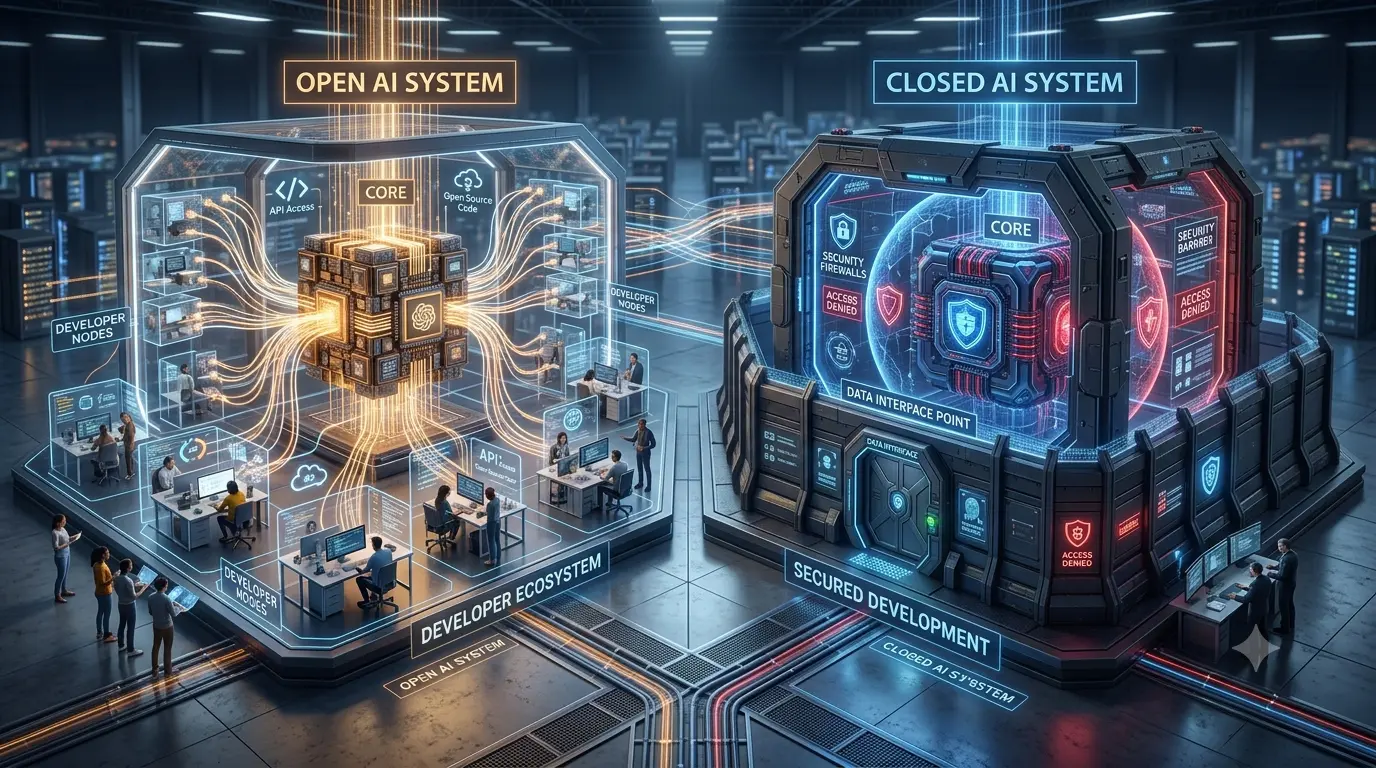
Artificial intelligence has created a new debate inside the technology industry.
It is not only about who builds the most powerful AI model.
It is about something deeper:
Who should control access to these models?
Some companies believe AI should become more open, allowing developers and researchers to inspect, modify, and build on powerful models.
Others argue that the most advanced AI systems require stronger controls because unrestricted access could create new security risks.
This debate is becoming one of the biggest questions shaping the future of AI.
What Are Open-Weight AI Models?
To understand the debate, it helps to understand what “open” means in AI.
Traditional AI services usually work like this:
A company builds a model.
Users access it through an app or API.
The internal model remains controlled by the company.
Open-weight models work differently.
The model weights — the data learned during training — can be made available to developers.
This allows people to:
- Run models locally.
- Modify them.
- Customize them.
- Study how they work.
- Build new applications.
However, open does not always mean completely unrestricted.
Different companies release different levels of access.
Why Some Companies Support Open Models
Supporters of open AI argue that wider access creates innovation.
Their argument:
If more developers can experiment with AI, more useful applications will be created.
Benefits may include:
More Innovation
Developers can adapt models for specific industries and use cases.
A healthcare company may customize a model differently from a software company.
More Competition
Open models can reduce dependence on a small number of AI providers.
Businesses have more choices instead of relying on only a few companies.
Research Benefits
Researchers can study AI systems more openly.
This can improve understanding of:
- Model behavior.
- Security issues.
- Limitations.
- Performance.
Why Some Companies Prefer More Control
The other side argues that powerful AI systems can create risks.
A highly capable model could potentially be misused for:
- Creating convincing misinformation.
- Automating harmful activities.
- Finding software vulnerabilities.
- Scaling cyberattacks.
Companies that favor controlled access argue that restrictions allow better monitoring and safer deployment.
Their position:
The more powerful the AI system, the more carefully it should be managed.
The Security Debate
Security is one of the biggest arguments in this discussion.
Open models create both opportunities and challenges.
Potential Benefits
Security researchers can examine models and find weaknesses.
Developers can build safety improvements.
Organizations can customize models for their own security requirements.
Potential Risks
Attackers may also gain access to powerful technology.
They could attempt to:
- Remove safety protections.
- Modify models for harmful purposes.
- Use AI capabilities without restrictions.
This creates a difficult question:
How much openness creates innovation, and how much creates unnecessary risk?
Why Businesses Care About This Debate
For businesses, this is not just a philosophical discussion.
The choice between open and closed AI affects:
Cost
Running an open model may reduce dependence on subscription-based AI services.
Privacy
Some companies prefer running models internally rather than sending data to external providers.
Customization
Businesses may want AI systems specifically trained for their own workflows.
Control
Companies often want more control over how AI systems behave.
The Rise of Hybrid AI
The future may not be completely open or completely closed.
Many companies are moving toward hybrid approaches.
Examples:
- Open models with safety controls.
- Private enterprise deployments.
- Cloud-hosted models with customization options.
- Smaller specialized models for specific tasks.
This approach tries to combine flexibility with security.
The Role of Companies Like NVIDIA and Microsoft
Large technology companies are becoming central to this debate.
Companies building AI infrastructure want businesses to have access to powerful AI tools.
But they also need those systems to be secure and reliable.
Microsoft, NVIDIA, and other companies are supporting different parts of the AI ecosystem:
- Hardware.
- Cloud platforms.
- AI development tools.
- Security systems.
The debate over openness will influence how these platforms develop.
Will Open Models Beat Closed Models?
There may not be one winner.
Different approaches may succeed in different situations.
Closed models may remain popular for:
- Enterprise applications.
- High-security environments.
- Managed AI services.
Open models may become popular for:
- Research.
- Custom applications.
- Local AI deployment.
The AI industry could end up looking similar to software development.
Some companies use commercial software.
Others use open-source alternatives.
Both can exist at the same time.
The Bigger Question: Who Controls AI?
The open versus closed AI debate is ultimately about control.
Should advanced AI become a widely available technology?
Or should the most powerful systems remain controlled by a small number of companies?
There is no simple answer.
More openness can encourage innovation.
More control can reduce risks.
The industry is still trying to find the right balance.
The Practical Takeaway
The AI race is no longer only about creating smarter models.
It is also about deciding how those models should be shared and used.
Open models could create more innovation and competition.
Controlled models could provide stronger oversight and security.
The future of AI will likely include both approaches.
The companies that succeed will be those that can balance access, safety, and practical usefulness.