
When people hear how AI systems understand text, they often imagine something similar to a search engine.
Modern AI systems use a technology called embeddings.
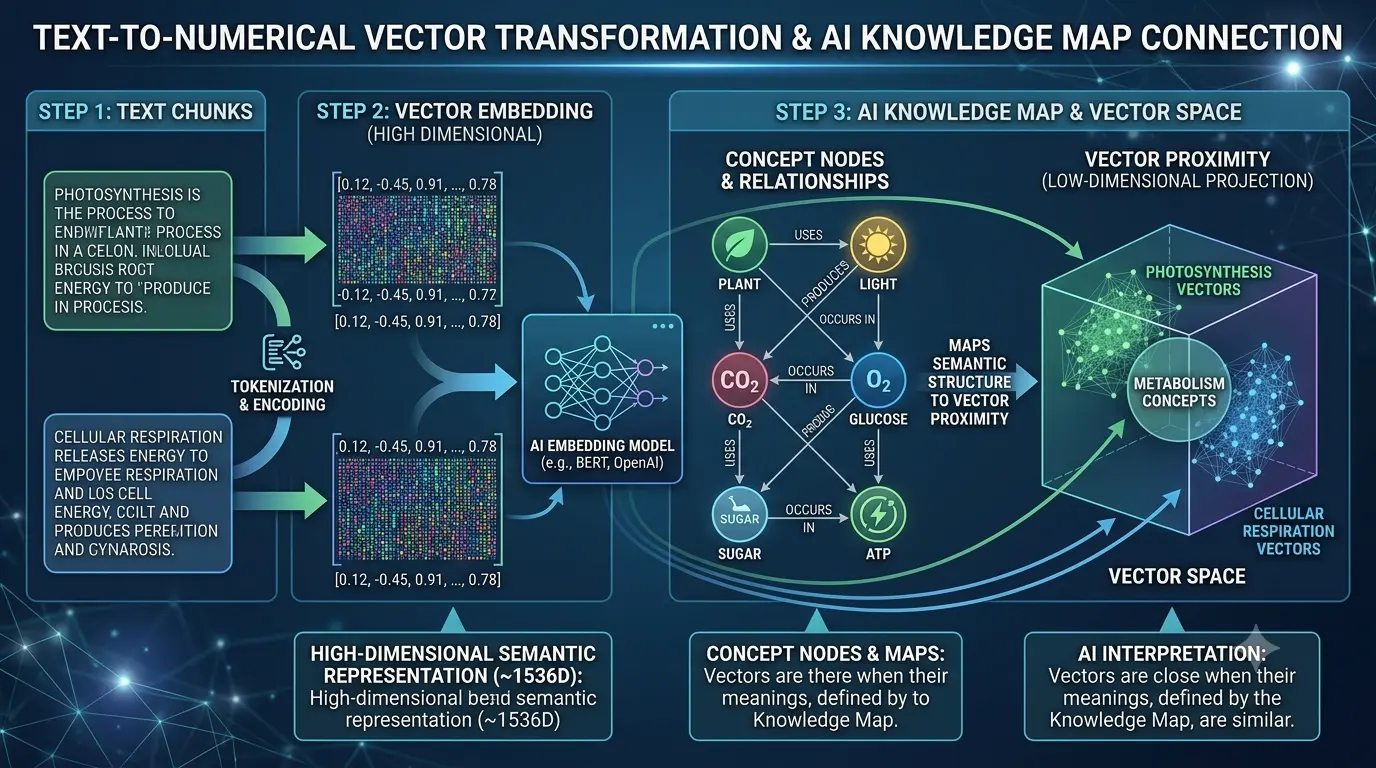
An embedding is a way of turning information into numbers so an AI system can compare meaning.
What Is an Embedding?
An embedding is a collection of numbers that represents the meaning of something.
That something could be:
– A word.
– A sentence.
– A document.
– An image.
– A piece of code.
AI models process mathematical data. Embeddings create a bridge between human language and machine calculations.
Why Keywords Alone Are Not Enough
Traditional search systems often depend heavily on matching words.
Embeddings help systems understand relationships between concepts instead of only matching exact wording.
How Embeddings Work
Embeddings convert information into numbers called vectors.
A vector is simply a list of numbers. Real embeddings may contain hundreds or thousands of numbers.
Similar concepts usually end up closer together in mathematical space.
The “Space” Behind Embeddings
When people say embeddings place concepts close together in vector space, they mean mathematical similarity, not a physical location.
Embeddings measure relationships between ideas.
Where Embeddings Are Used
Embeddings power:
– Semantic search.
– Recommendations.
– AI assistants.
– Retrieval-augmented generation (RAG).
How Embeddings Power RAG Systems
Retrieval-augmented generation uses embeddings to help AI systems find relevant information before generating an answer.
The process:
1. Documents are converted into embeddings.
2. The user’s question is converted into an embedding.
3. Similar information is retrieved.
4. The AI uses those documents to answer.
Why Embeddings Help Large Document Collections
Embeddings help systems find related information even when the wording is different.
They connect similar ideas rather than only matching identical words.
Embeddings Are Not the Same as AI Memory
Embeddings do not give AI permanent memory.
They are mathematical representations stored and searched by systems.
What Is a Vector Database?
Vector databases are designed to compare embeddings and find similar information quickly.
Examples include:
– Pinecone.
– Weaviate.
– Milvus.
– Chroma.
Embeddings Beyond Text
Embeddings can represent:
– Images.
– Audio.
– Code.
Why Embeddings Do Not Understand Like Humans
Embeddings capture patterns in relationships.
They do not give AI emotions, experiences, or human awareness.
The Limits of Embeddings
Embeddings can struggle with:
– Very specific facts.
– Ambiguous questions.
– Outdated information.
The Practical Takeaway
Embeddings are the bridge between human information and machine-readable patterns.
They help AI systems find connections between ideas and power modern search, RAG systems, and many AI applications.