
The artificial intelligence boom has created a new dependency.
Almost every major AI company needs enormous amounts of computing power.
And for years, one company has been the obvious choice:
NVIDIA.
Its GPUs have become the foundation of many AI systems, from research laboratories to cloud platforms.
But companies building the next generation of AI infrastructure do not want to depend on a single hardware supplier.
Microsoft is one of the companies trying to create more flexibility.
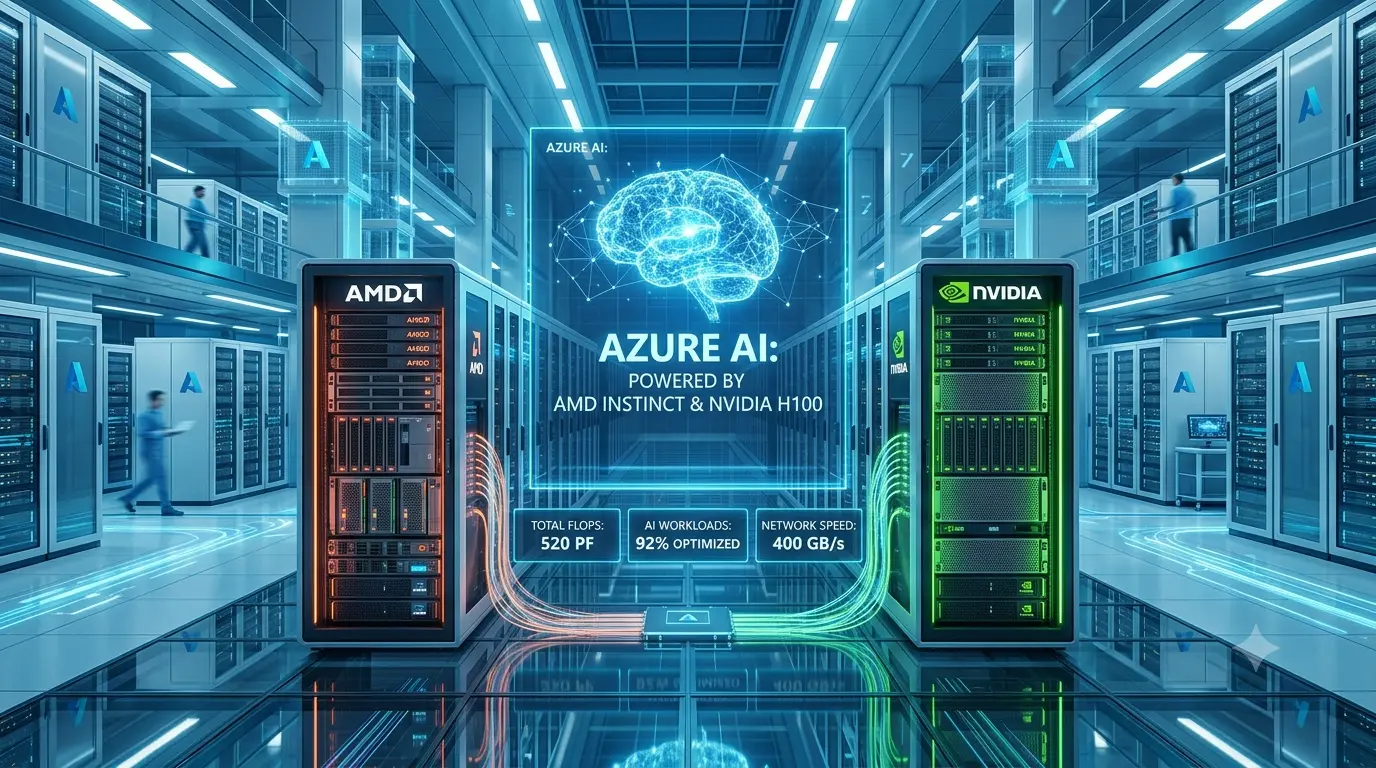
By expanding its use of different AI hardware options, including AMD-powered infrastructure, Microsoft is building a future where AI computing does not rely on only one chip provider.
The reason is simple:
The AI industry is too important to have a single point of dependence.
Why AI Infrastructure Has Become a Strategic Problem
AI models require enormous computing resources.
Training advanced models can require thousands of specialized processors running together.
But training is only one part of the equation.
Companies also need computing power for:
- Running AI applications.
- Serving millions of users.
- Enterprise AI tools.
- Data analysis.
- AI agents.
This demand has created a global competition for AI infrastructure.
Cloud companies are investing billions into:
- Data centers.
- Networking systems.
- AI processors.
- Energy capacity.
The companies that control this infrastructure will influence how quickly AI develops.
NVIDIA’s Dominance Created a New Challenge
NVIDIA became the leader in AI computing because of its GPUs and software ecosystem.
Its CUDA platform became a standard tool for AI developers.
This created a powerful advantage.
Companies choosing AI hardware do not only ask:
“Which chip is fastest?”
They also ask:
“Which platform already works with our software?”
This is why replacing NVIDIA is difficult.
The hardware matters.
The ecosystem matters more.
Why Microsoft Wants More AI Hardware Options
Microsoft operates Azure, one of the largest cloud computing platforms in the world.
Azure provides AI services to businesses, developers, and organizations globally.
For Microsoft, relying on a single hardware supplier creates challenges.
Multiple suppliers can provide:
- More supply flexibility.
- Better pricing options.
- Greater control over infrastructure planning.
- Different performance choices.
This is similar to how cloud providers have traditionally supported multiple processors and technologies.
The goal is not necessarily to replace NVIDIA.
The goal is to avoid being dependent on only one option.
AMD’s Role in the AI Infrastructure Market
AMD has been expanding its AI strategy through:
- Data-center CPUs.
- AI accelerators.
- Networking technology.
- Software development tools.
The company is positioning itself as an alternative for organizations that need AI computing capacity.
AMD’s biggest challenge is not creating competitive hardware.
It is convincing developers and businesses that its ecosystem can support their workloads.
This is the same challenge every NVIDIA competitor faces.
The Real Competition Is Happening Behind the Chips
AI hardware discussions often focus on processor specifications.
But large AI deployments depend on much more.
A complete AI infrastructure system includes:
Hardware
The processors doing the actual computing.
Software
The frameworks and tools developers use.
Networking
The systems connecting thousands of processors.
Cloud Integration
The ability to deploy AI services reliably at scale.
A company that succeeds in AI infrastructure needs all four.
Why Cloud Companies Want Competition
Cloud providers have a unique position.
They buy enormous amounts of hardware.
They also have millions of customers depending on their services.
More hardware competition gives them options.
For example:
Different AI workloads may benefit from different hardware.
A research company training a massive model may need different systems from a business running thousands of AI customer support requests.
One solution may not fit every situation.
What This Means for Businesses
Most companies will never directly purchase AI processors.
Instead, they will use AI through:
- Cloud platforms.
- Software subscriptions.
- Enterprise AI services.
However, the infrastructure behind those services affects users.
More competition could eventually lead to:
- Better AI availability.
- Lower costs.
- Faster improvements.
- More choices.
The AI hardware race may seem distant, but it shapes the tools businesses use every day.
Could AMD Become a Major AI Infrastructure Player?
AMD has a real opportunity.
The AI market is expanding quickly, and demand for computing power continues increasing.
However, NVIDIA still has major advantages:
- Developer ecosystem.
- Software maturity.
- Existing customer relationships.
- Market experience.
AMD does not need to completely replace NVIDIA.
Even becoming a strong second option would significantly change the market.
The Future AI Stack Will Be More Diverse
The early AI boom was heavily centered around NVIDIA hardware.
The next stage may look different.
A mature AI industry could include:
- Multiple chip providers.
- Different AI architectures.
- Specialized hardware.
- More open software ecosystems.
Competition at every layer could help the industry grow faster.
The Practical Takeaway
Microsoft’s support for multiple AI hardware platforms shows an important shift.
The AI race is no longer just about building better models.
It is also about controlling the infrastructure that powers them.
NVIDIA remains the market leader.
But companies like AMD are creating alternatives, and cloud providers want those alternatives to succeed.
The future of AI may not belong to one chip company.
It may belong to the companies that create the most flexible, reliable, and scalable AI ecosystems.