
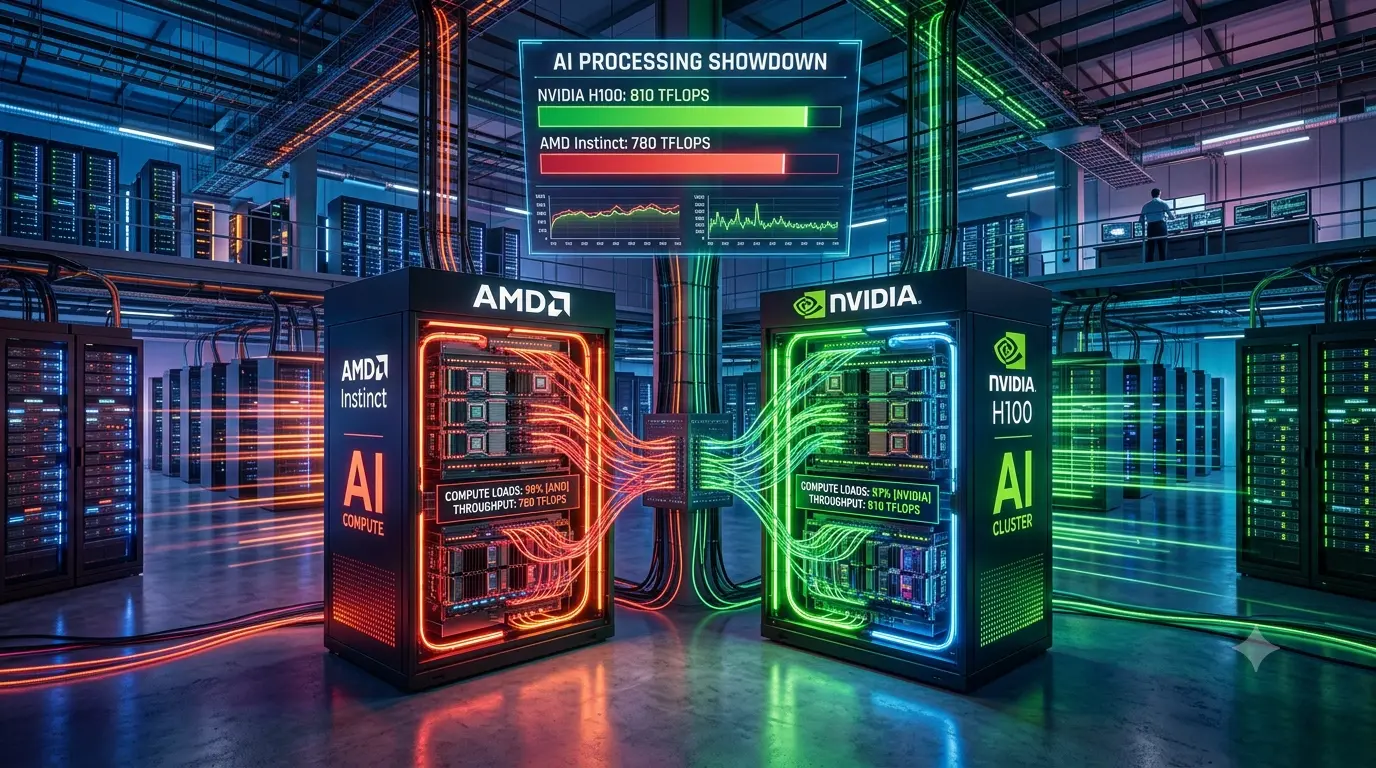
For years, the AI hardware race looked simple.
NVIDIA made the chips.
Everyone else tried to catch up.
The company’s GPUs became the foundation of modern AI systems, powering large language models, research projects, and enterprise AI platforms around the world.
But the AI market is becoming much larger.
AMD is now making a serious push into AI infrastructure, and recent growth in its data-center business shows that demand for alternative hardware is increasing.
However, the biggest challenge for AMD is not only building faster chips.
It is building the software ecosystem around those chips.
That is where NVIDIA built its biggest advantage.
The AI Hardware Race Is Not Just About Hardware
When people talk about AI computing, they often focus on processors.
How many cores does a chip have?
How fast can it process data?
How much memory does it support?
Those things matter.
But modern AI systems depend on much more than hardware.
Companies also need:
- Software frameworks.
- Developer tools.
- Optimized libraries.
- Cloud support.
- Enterprise compatibility.
A powerful chip is less useful if developers cannot easily build on it.
This is the reason NVIDIA has remained ahead.
NVIDIA’s Real Advantage: The Software Ecosystem
NVIDIA’s success in AI is closely connected to CUDA.
CUDA is a software platform that allows developers to use NVIDIA GPUs for computing tasks beyond traditional graphics.
Over many years, developers built AI tools and applications around NVIDIA’s ecosystem.
This created a powerful cycle:
More developers used NVIDIA hardware.
More software was optimized for NVIDIA.
More companies chose NVIDIA because the ecosystem already existed.
The advantage became bigger over time.
AMD’s AI Strategy Goes Beyond Chips
AMD is not simply trying to create a faster processor.
The company is building a broader AI platform.
Its AI strategy includes:
- Data-center CPUs.
- AI accelerators.
- Networking technology.
- Software tools.
One important part of this strategy is ROCm.
ROCm is AMD’s open software platform designed to help developers run AI workloads on AMD hardware.
The challenge is clear:
Convincing developers to move from a mature NVIDIA ecosystem to a competing platform takes time.
Why Software Matters More Than Ever
AI development has become extremely software-dependent.
Researchers and companies use frameworks such as:
- PyTorch.
- TensorFlow.
- Custom AI platforms.
These tools need optimization.
If developers experience compatibility issues or performance problems, hardware adoption becomes harder.
This is why the AI hardware competition is different from previous chip battles.
A company cannot win only by making good silicon.
It needs developers, researchers, and businesses building around it.
Why AMD Is Still Gaining Ground
Despite NVIDIA’s advantage, AMD has several opportunities.
Growing AI Demand
The AI market is expanding quickly.
Cloud companies, enterprises, and research organizations need more computing capacity.
There may be room for multiple major suppliers.
Companies Want Alternatives
Large technology companies do not want to depend on a single hardware provider.
Using multiple suppliers can help with:
- Supply availability.
- Pricing.
- Long-term planning.
Open Ecosystem Approach
AMD’s software strategy focuses on openness.
Some developers and organizations prefer platforms that provide more flexibility.
Why Microsoft Matters in This Competition
Cloud providers are a major part of the AI hardware market.
Microsoft Azure runs massive AI workloads and needs access to large amounts of computing power.
Supporting multiple hardware options gives Microsoft more flexibility.
For cloud companies, the question is not always:
“What is the fastest chip?”
It is also:
“How can we provide reliable AI computing at global scale?”
Could AMD Replace NVIDIA?
Probably not in the short term.
NVIDIA has several major advantages:
- A mature software ecosystem.
- Strong developer adoption.
- Established cloud partnerships.
- Deep AI industry relationships.
AMD’s opportunity is different.
The company does not need to completely replace NVIDIA.
Capturing a significant share of the AI infrastructure market would already represent major growth.
The Next AI Battle Will Be About Ecosystems
The technology industry has seen similar battles before.
A product can be technically excellent but still struggle if the surrounding ecosystem is weak.
AI hardware is heading in the same direction.
The winners will likely be companies that combine:
- Strong hardware.
- Reliable software.
- Developer support.
- Enterprise adoption.
The chip itself is only one piece.
What This Means for Businesses Using AI
Most businesses will not directly buy AI processors.
They will access AI through:
- Cloud platforms.
- AI applications.
- Enterprise software.
However, hardware competition affects everyone.
More competition can lead to:
- Better AI availability.
- Lower costs.
- Faster innovation.
The companies building AI infrastructure today will influence what AI tools look like in the future.
The Practical Takeaway
AMD’s challenge to NVIDIA is not simply a battle between two chip companies.
It is a battle between ecosystems.
NVIDIA built a huge lead by making AI development easier on its platform.
AMD’s next challenge is proving that developers and businesses have a reason to build on its technology too.
The future of AI computing will not be decided only by who makes the fastest chip.
It will be decided by who builds the strongest platform around it.